
“As clinicians began adapting the Alcoholics Anonymous model to sexual addiction and problematic sexual behavior, they also carried forward many of its assumptions about partners.
Wives and husbands of addicts were often described as co-dependent, co-addicted, or enabling.” ~ Dr. Jake Porter, LPC, NCC, CPC
Table of Contents
Why Betrayed Partners Were Mislabeled as Enabling, Co-Dependent, or Co-Addicted
For many years, the addiction treatment field broadly borrowed heavily from the framework of Alcoholics Anonymous. The AA model brought structure, language, and hope to millions of individuals and families whose lives were being devastated by addiction.
As clinicians began adapting that model to sexual addiction and problematic sexual behavior, they also carried forward many of its assumptions about partners.
Wives and husbands of addicts were often described as co-dependent, co-addicted, or enabling. The thinking was straightforward: if addiction was present in the relationship, dysfunction must exist on both sides of the system.
Those early clinicians were pioneers. They were addressing issues most people wouldn’t even name, let alone treat. Many couples were helped because of their courage to confront sex addiction directly.
But over time, something didn’t quite fit.
In offices across the country, therapists began noticing that many partners did not present as controlling, addicted to chaos, or pathologically fused with their spouse’s behavior.
They presented as shattered. Hypervigilant. Disoriented. Traumatized.
As research caught up with clinical observation—especially through the work of Dr. Barbara Steffens and the development of APSATS (the Association of Partners of Sex Addicts Trauma Specialists)—the field began to shift.
Tending to trauma: essential for healing relationships
What had long been interpreted as co-dependency often made far more sense through a trauma lens.
When hidden betrayal is discovered in a committed relationship, the nervous system does not respond with disappointment and hurt. It responds with threat.
And if we misunderstand that threat response, we risk deepening the injury rather than healing it.
This is why a trauma-informed lens is not optional in relational recovery after the discovery of hidden betrayal.
A recovering sex addict may be doing meaningful work—attending meetings, installing accountability software, seeing a therapist, building new habits.
All of that matters.
But sobriety and relational safety are not the same thing.
A marriage marked by hidden betrayal is unlikely to heal unless the recovery process addresses the traumatic impact of secrecy, deception, and attachment rupture.
You cannot argue someone out of a trauma response.
You cannot logic someone into trust.
You must tend to the trauma.
So what is betrayal trauma?
Defining betrayal trauma
Betrayal trauma is the traumatic stress response that occurs when the person you depend on for emotional safety becomes the source of danger.
At its core, it is an attachment injury.
The one person who was supposed to protect me, choose me, and be honest with me has instead introduced threat into our bond.
That realization destabilizes far more than a single moment.
It destabilizes the shared story of the relationship.
How betrayal trauma affects the brain and memories
Neurobiologically, the effects are significant. The amygdala—our brain’s alarm system—becomes hypersensitive, scanning constantly for signs of further danger.
The hippocampus, responsible for organizing memory into coherent narrative, scrambles to reconcile new information with years of shared history. Many betrayed partners describe this as having their “filing cabinet” dumped onto the floor.
Memories once associated with warmth now feel contaminated. Ordinary routines—work trips, phone notifications, late arrivals—become charged with meaning.
The body begins living in a state of hypervigilance, not because the person is dramatic, but because the brain is doing exactly what it was designed to do when safety is compromised.
Ways betrayal trauma shows up in relationships
Importantly, betrayal trauma does not stay contained inside one partner. It shows up in the relationship itself.
Recovering addicts often tell me that the conflict feels worse after discovery and even into the first months of recovery than it did before. That can be confusing. “I’ve stopped acting out,” they’ll say. “So why are things still so volatile?”
The answer is that while the behavior may have ceased, the nervous system of the betrayed partner is still trying to assess whether the environment is safe.
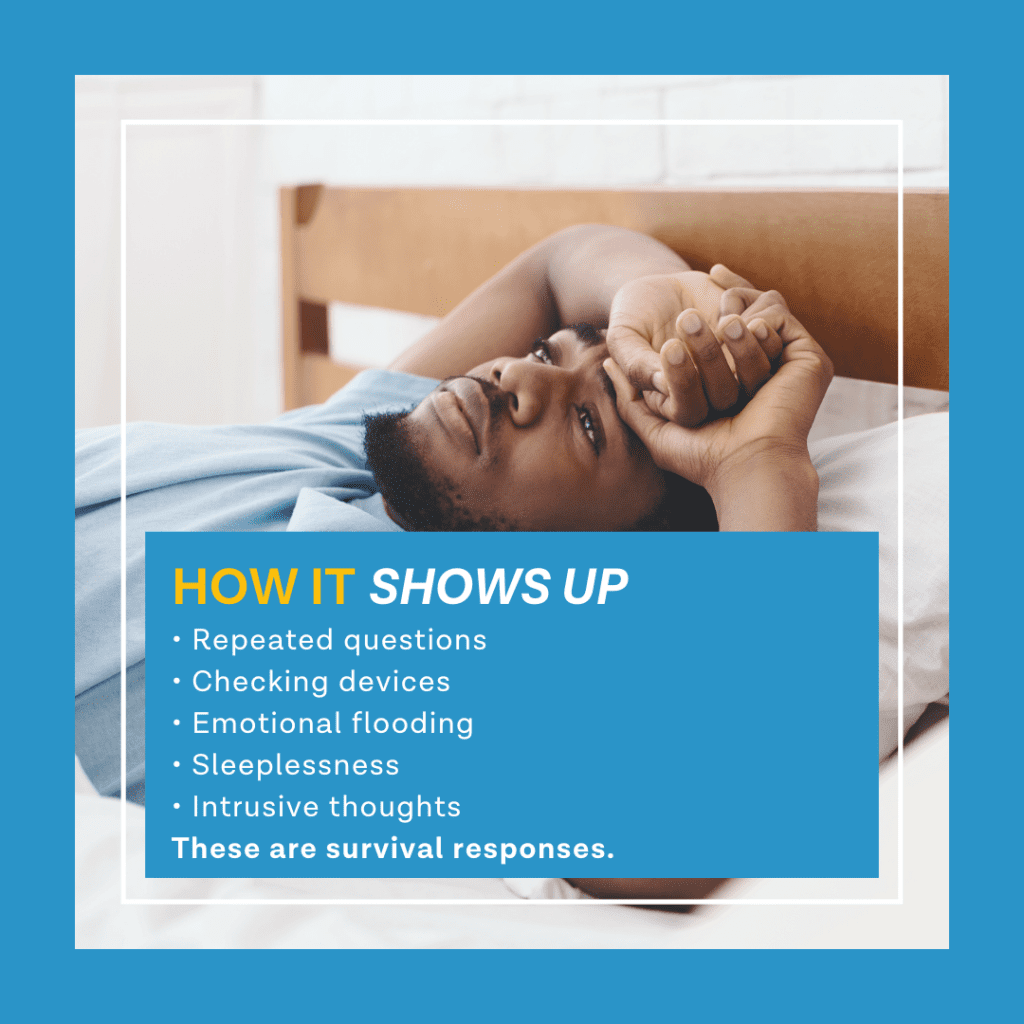
This is why there may be repeated questions, even about events that have already been discussed. It is why devices are checked, timelines are revisited, and seemingly small inconsistencies spark disproportionate reactions.
It is why emotional flooding can occur during ordinary disagreements.
What feels to the recovering partner like interrogation, control, or refusal to “move on” is often a survival response aimed at preventing further harm.
The same person who feels unsafe is also the person the betrayed partner is wired to turn toward for comfort. That creates a painful push–pull dynamic inside the bond. Longing and fear are occupying the same space.
Common symptoms of betrayal trauma within a relationship include what appears to be obsessive rumination about the betrayal and compulsive searching for additional information. However, for the betrayed partner, these are primal threat responses in an effort to seek safety.
Other symptoms include difficulty sleeping, intrusive thoughts, emotional swings between anger and despair, numbness, and a profound questioning of reality itself.
Many partners wonder, “Was any of it real?”
These reactions can be misinterpreted as instability or pathology. In truth, they are protective responses. The nervous system is trying to rebuild a coherent map of the world.
Necessary steps to healing from betrayal trauma
Healing requires more than stopping destructive behavior. It requires restoring safety inside the attachment bond.
In my work with couples, I describe recovery as unfolding in three broad phases. These three phases are also present in APSATS’s Multidimensional Partner Trauma Model (MPTM) and Judith Hermann’s classic trauma recovery model.
Step 1: Seeking safety and stability
The first phase is seeking safety and stability. This is where sobriety is non-negotiable, but it is not sufficient. Full honesty, transparency, and consistent accountability are required.
Emotional safety must be built through empathy, not defensiveness.
The betrayed partner needs to see and feel that the betraying partner understands the magnitude of the injury. Without this foundation, deeper processing cannot occur because the nervous system remains braced for impact.
Step 2: Grieving together
The second phase involves grieving together.
Once safety has been established with some consistency, couples begin facing the losses caused by the betrayal:
- Loss of trust
- Loss of the relationship as it was understood
- Loss of innocence in your shared narrative
This is where trauma triggers can gradually give way to grief waves. Instead of reacting purely from threat, the couple begins making meaning of what happened.
Questions shift from “How could you?” to “What was going on inside of us and inside of you?”
This is collaborative, not adversarial. It requires courage and humility from both partners.
Step 3: Rebuilding and renewal
The final phase is rebuilding and renewal. Here, couples are no longer merely trying to survive the fallout. They are intentionally constructing a new relational architecture. Trust is rebuilt brick by brick through consistent action aligned with values.
Patterns of secrecy are replaced with transparency. Old attachment wounds are addressed with new forms of connection.
For some couples, the very crisis that nearly destroyed them becomes the catalyst for a deeper honesty and intimacy than they had ever previously known.
Such transformation does not happen quickly, and it does not happen by bypassing pain. It happens by facing it together.
Words to the wise - where to start first to heal betrayal trauma
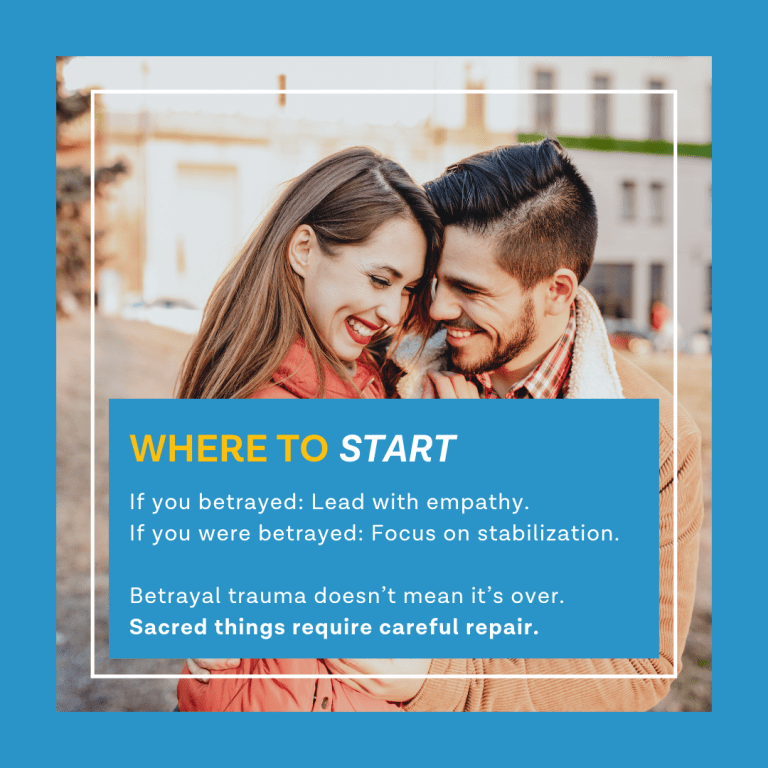
If you are the betrayer in a relationship
If you are the betraying partner and you want your marriage to heal, the most practical starting point is empathy. Not explanation. Not defending your progress. Empathy.
When your partner is triggered, resist the impulse to correct or persuade. Instead, acknowledge the pain. Over time, consistent empathy helps regulate a traumatized nervous system and reestablish safety inside the bond.
14-Day Free Trial
Protection From Pornography
Change your habits, change your life: Start our 14-day free trial to help get rid of pornography for good.
If you are the betrayed
If you are the betrayed partner, focus first on stabilization. Trauma creates urgency, and urgency can drive decisions that are reactive rather than grounded.
Prioritize sleep, support, and professional guidance. Clarity tends to emerge from regulation, not from panic.
Betrayal trauma is not a sign that a relationship is beyond hope. It is a sign that something sacred was broken inside the bond. Sacred things require careful, trauma-informed repair. When that repair is approached with humility, honesty, and courage, healing is not only possible—it can be transformative.
If you’re interested in where you might be in this three-phase healing process, you might want to take my free Couple-Centered Recovery® Phases of Healing Assessment.

Meet Dr. Jake Porter
Dr. Jake Porter, LPC, NCC, CSAT-S, CMAT, CCPS, CPAP, CCTP, CPC, President & CEO of Daring Ventures, is a marriage therapist helping couples overcome cheating and betrayal to restore trust and connection in their relationship.
You can connect with him on Instagram to get more tips or learn more about his couples therapy work.
14-Day Free Trial
Protection From Pornography
Change your habits, change your life: Start our 14-day free trial to help get rid of pornography for good.